





10 Best UserVoice Alternatives in 2026: Votes, Roadmaps, or Real Ticketing?

Shalin
Founder & CEO HappyFox
August 13, 2026
The best UserVoice alternatives are Canny, HappyFox, Productboard, Frill, Aha! Ideas, Featurebase, Pendo, Savio, UserJot, Fider.
Somewhere in a support queue right now, a customer is asking for a feature that already has forty duplicate requests scattered across three different email threads, and nobody can see the pattern.
That's the gap UserVoice was built to close: a public place to log, vote on, and track requests instead of losing them. But UserVoice was never a support ticketing tool, and it still isn't one. It doesn't route a request to the right agent, enforce a response-time SLA, or give a support lead a dashboard of what's actually breaking, and teams that outgrow it are usually looking for one of two very different products, not a better version of the same thing.
This guide sorts ten uservoice alternatives by what they're actually built for.
Quick-Match: Find Your Fit by Switching Reason
|
If you need... |
|
|---|---|
|
|
|
|
|
|
|
|
|
|
|
|
|
|
|
|
|
|
How We Evaluated This List
Picking a feedback tool usually comes down to the same three checks: what it actually costs, what real customers say once they're using it, and whether it does the job you actually need. That's exactly what we ran on every tool below before it made this list.
-
Pricing:
Every tool was checked against its own live pricing page today, not pulled from a stale comparison chart or a third-party aggregator.
-
Reviews:
Where a real, named customer review existed, it's quoted here with the reviewer's role and the platform it came from. Where review volume was too thin to be meaningful, like a single G2 review, that's disclosed rather than dressed up as a rating.
-
Inclusion Criteria:
Does the tool solve the same job UserVoice does, or does it solve a job that only looks similar from a distance? UserVoice collects and ranks feature ideas. It doesn't route support tickets, enforce SLAs, or give a support lead operational visibility, so anything claiming to replace it has to be judged on the voting-and-roadmap job specifically.
Why Teams Search for a UserVoice Alternative
-
The quote depends on the call, not a rate card:
Lastly, the pricing might be a bit high for smaller organizations, but the value provided makes it worthwhile."- Verified User, IT Services, Enterprise (G2, Dec 18, 2024)
-
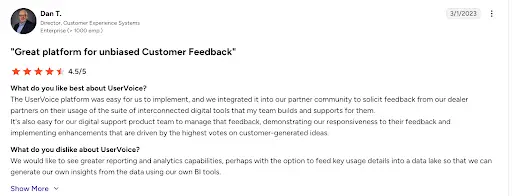
Reporting stops at the feedback layer::
"We would like to see greater reporting and analytics capabilities, perhaps with the option to feed key usage details into a data lake so that we can generate our own insights using our own BI tools."- Dan T., Director, Customer Experience Systems, Enterprise (G2, Mar 1, 2023)
-
Enterprise accounts hit structural limits fast:
Some of the functionality is a bit limited for enterprise organizations. For example, you can only have 1 system-wide knowledge base."- Oren Shatken, Product Manager, Angie's List (TrustRadius, Jul 22, 2014)
-
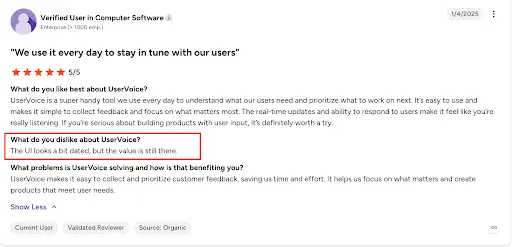
The interface hasn't kept pace:
"The UI looks a bit dated, but the value is still there."-Verified User, Computer Software, Enterprise (G2, Jan 4, 2025)
UserVoice Alternatives Compared
|
Tool |
||||
|---|---|---|---|---|
|
|
|
|
|
|
|
|
|
|
|
|
|
|
|
|
|
|
|
|
|
|
|
|
|
|
|
|
|
|
|
|
|
|
|
|
|
|
|
|
|
|
|
|
|
|
|
|
|
|
|
|
|
|
|
|
|
|
|
|
|
|
|
|
|
|
The 10 Best UserVoice Alternatives in 2026

1. Canny


Canny built its reputation on a clean, fast-to-deploy voting board, and it's still the tool most product-led teams reach for first. What's changed is the AI layer sitting underneath it: Autopilot now pulls feedback automatically from support tools like Intercom, Zendesk, and Freshdesk, deduplicates it, and ties requests to MRR impact so a product manager can see which votes actually matter financially. Pricing scales by tracked users rather than seats, with a 20% discount for paying annually, and a real free tier exists for teams just getting started rather than a time-limited trial.
Key Features
-
MRR-weighted prioritization
-
Autopilot AI feedback capture from support tools
-
Public and private roadmaps
-
Changelog widget with scheduled releases
-
User segmentation by plan tier
-
Vote-on-behalf for support and sales teams
-
Chrome extension
-
Slack and Teams notifications
-
MCP connectors for AI tools
Customer fit
-
Best for:
Product-led SaaS teams that want feedback capture automated from existing support and sales conversations.
-
Not ideal for:
Deep product-usage analytics aren't native here; Canny relies on integrations rather than built-in behavioral tracking, and the jump from the free tier's 25 tracked users to paid plans arrives faster than some smaller teams expect.
Reviews and Pricing
-
Reviews:
"I like that I can easily communicate with my customers if a feature request is possible or not, and it notifies everyone who upvoted the post. I also love how I can easily merge feature requests that are similar, so all upvotes count under a single feature request."- Phil L., Co-founder, Small Business (G2, Jul 26, 2024)
-
Pricing:
Free (25 tracked users) · Pro from $79/mo billed yearly (100+ tracked users, PM tool integrations) · Business, custom pricing (5,000+ tracked users, SSO, CRM sync, SOC 2).
(Source: "Canny" pricing, Aug 2026)

2. HappyFox
HappyFox doesn't belong on this list as a feedback-board replacement, and that's worth saying plainly first. It has no public voting widget and no customer-facing roadmap. What it does have is a help desk built for the moment a feature request stops being an idea and becomes a ticket needing an owner, a response-time target, and a paper trail. When "collecting feedback" really means "our support queue is full of requests we can't triage," HappyFox tags, routes, and reports on those tickets inside the same system handling every other customer issue, with SLA enforcement most pure feedback tools were never built to offer.
Key Features
-
Omnichannel inbox across email, phone, live chat, and web portal
-
Smart Rules automation
-
Skill-based and round-robin routing
-
SLA management by category and priority
-
AI Copilot for response drafting and summarization
-
Custom ticket tagging for feature-request tracking
-
Scheduled reporting dashboards
-
Multi-brand support
-
100+ native integrations
-
SOC 2 Type II and GDPR compliance
Customer fit
-
Best for:
Support and IT teams whose feature requests already surface as tickets and need SLA enforcement, routing, and reporting attached to them, not another standalone board.
-
Not ideal for:
Product teams whose primary need is a public-facing voting board or a customer-visible roadmap; HappyFox has no native feature-voting product, so teams that specifically need that should look at Canny, Frill, or UserJot instead.
Reviews and Pricing
-
Reviews:
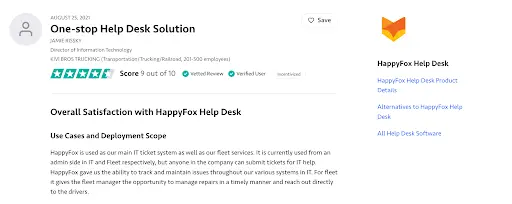
"Honestly, if there is a need for tracking anything from IT and service to maintenance scheduling, they have a solution. I have been beyond pleased with the system and the automation that you can set up."- Jamie Rissky, Director of Information Technology, 201 to 500 employees (TrustRadius, Aug 25, 2021)
-
Pricing:
Basic $24/agent/mo · Team $49/agent/mo · Pro $99/agent/mo (all billed annually) · Enterprise Pro, custom pricing. HappyFox AI is available as an add-on starting from $14/agent/month on top of the base plan, with no per-resolution fees and the entry tier covering 500 interactions/month.
(Source: "HappyFox" pricing, Aug 2026)

3. Productboard
Productboard is built for the strategy layer above idea collection: turning scattered customer insight into a roadmap that a whole product org can align around. It centralizes feedback notes, applies prioritization frameworks, and connects directly to engineering tools like Jira so a feature's status is visible from first mention to shipped release. Named customers include Zoom, Salesforce, and Autodesk, which signals where it's strongest: large, process-heavy product organizations rather than early-stage teams. The pricing model separates "makers," the PMs who own strategy, from unlimited free contributors, which keeps cost predictable even as more people across the company submit feedback.
Key Features
-
Spark AI assistant with workspace-aware chat and automated finding
-
Customer insights repository
-
Timeline and column-based roadmap templates
-
Custom prioritization formulas
-
Product usage integrations with Amplitude and Mixpanel
-
Customer portal with SSO and localization
-
Dependency tracking
-
Salesforce integration at the enterprise tier
Customer fit
-
Best for:
Structured product teams that need roadmap planning tied directly to customer insight, particularly larger organizations already running formal PM processes.
-
Not ideal for:
Small teams or solo PMs; multiple reviewers describe a real learning curve and an interface that takes time to onboard into, and the free tier caps out at 500 feedback notes.
Reviews and Pricing
-
Reviews:
The staff at Productboard is incredible and their product is beautiful. One of the nicest roadmap views you will ever see!"Jacob B., Content Manager (Capterra, Aug 28, 2022)
-
Pricing:
Free (50 AI credits/mo, 500 feedback notes) · Plus $19/maker/mo billed annually · Business $59/maker/mo, 2-maker minimum · Enterprise, custom, 5-maker minimum.
(Source: "Productboard" pricing, Aug 2026)

4. Frill
Frill packages ideas, roadmap, and changelog into a single embeddable widget, and its main selling point is how little setup stands between signing up and having a working feedback loop live on your site. It markets itself directly against Canny and other board-plus-changelog tools, leaning on its interface as the differentiator rather than depth of features. Every paid tier includes unlimited admins and unlimited tracked users, so cost doesn't creep up as more of the team gets involved, though features like white labeling, NPS surveys, and unlimited polling sit behind higher tiers as paid add-ons.
Key Features
-
Embeddable ideas board with auto-surfacing top requests
-
Drag-and-drop roadmap with one-click status updates
-
Drag-and-drop roadmap with one-click status updates
-
Unlimited announcements and changelog on every paid plan
-
NPS and CSAT surveys
-
Smart duplicate detection and merging
-
Guest and anonymous submission
-
Bulk CSV import including direct Canny migration
-
SSO and webhooks on higher tiers
Customer fit
-
Best for:
Startups, agencies, and small SaaS teams wanting feedback, roadmap, and changelog consolidated into one lightweight, affordable tool.
-
Not ideal for:
White labeling and unlimited surveys both sit behind paid add-ons rather than being included; some reviewers also note gaps in integrations that larger, older competitors have had more time to build out.
Reviews and Pricing
-
Reviews:
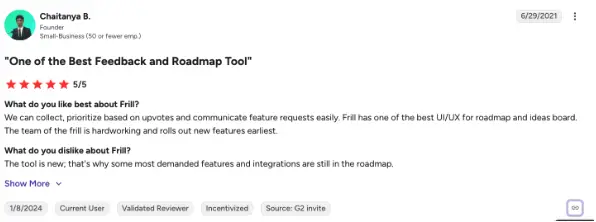
"We can collect, prioritize based on upvotes and communicate feature requests easily. Frill has one of the best UI/UX for roadmap and ideas board. The team of the frill is hardworking and rolls out new features earliest."Chaitanya B., Founder, Small Business (G2, Jun 29, 2021)
-
Pricing:
Startup $25/mo (50 active ideas) · Business $49/mo (unlimited ideas) · Growth $149/mo (white labeling add-on) · Enterprise $349/mo (SOC 2, audit logs). 14-day free trial, no free-forever tier.
(Source: "Frill" pricing, Aug 2026)

5. Aha! Ideas
Aha! Ideas is the crowdsourcing front door to the broader Aha! product suite, and it shows in how deep the tooling goes: branded portals with unlimited users, a Salesforce opportunity report tying ideas to pipeline value, and an AI assistant that catches duplicate submissions before they clutter a backlog. Both tiers bundle Aha! Whiteboards and Aha! Knowledge at no extra cost, with a natural upgrade path into Aha! Roadmaps once a team needs full strategy planning. Unlike most tools here, both tiers are transparently priced with no "contact sales" gate, though there's no free plan and a three-seat minimum.
Key Features
-
Branded, unlimited-user ideas portals
-
Elle AI assistant for theme detection and duplicate merging
-
Proxy voting for sales and support teams
-
Salesforce and HubSpot revenue-linked reporting
-
Dynamic intake forms
-
In-app widgets and polls
-
Customer segmentation by industry and revenue
-
Automation rules for tracking in-demand requests
Customer fit
-
Best for:
Product teams already invested in, or planning to adopt, the wider Aha! suite who want idea management formally linked to CRM pipeline data.
-
Not ideal for:
Solo users or very small teams, given the three-paid-user minimum and no free tier; reviewers describe it as a premium product that can feel like more tool than a simple startup needs.
Reviews and Pricing
-
Reviews:
"Aha is extremely powerful and customizable... Very user friendly and the different views can be tailored for the different stakeholders. It is also extremely powerful for the part to communicate with clients: the Ideas portal is awesome."-Nicola R., Head of Product Management, Small Business (G2, Jan 22, 2026)
-
Pricing:
Essentials from $39/user/mo billed annually, 3-user minimum · Advanced from $59/user/mo billed annually, 3-user minimum. No published enterprise or custom tier.
(Source: "Aha! Ideas" pricing, Aug 2026)

6. Featurebase
Featurebase's pitch is consolidation: helpdesk, feedback board, roadmap, changelog, and an AI support agent under one subscription, aimed at teams tired of stitching five separate tools together. A genuinely free tier covers one seat with unlimited conversations, and the paid tiers add AI-driven ticket resolution billed per resolution on top of the seat price, which is worth budgeting for separately since it scales with support volume rather than headcount alone. Very early-stage companies, under two years old with six or fewer employees, can also apply for a startup discount that cuts pricing substantially.
Key Features
-
Unified helpdesk and feedback inbox
-
Fibi AI agent for automated resolutions
-
In-app feedback widgets
-
AI-powered duplicate detection
-
Revenue and segment-based prioritization
-
Public roadmap auto-synced to feedback status
-
Round-robin assignment and SLAs at higher tiers
-
SOC 2 and GDPR compliance
-
One-click migration tooling
Customer fit
-
Best for:
Teams actively trying to replace several separate support and feedback tools with a single subscription.
-
Not ideal for:
Teams with high support volume, since the per-resolution AI fee adds a variable cost on top of seat pricing that's harder to predict than flat per-seat competitors.
Reviews and Pricing
-
Reviews:
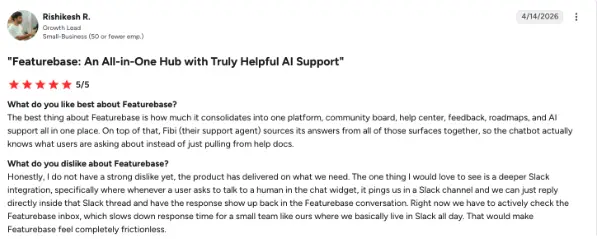
"The best thing about Featurebase is how much it consolidates into one platform, community board, help center, feedback, roadmaps, and AI support all in one place. On top of that, Fibi (their support agent) sources its answers from all of those surfaces together, so the chatbot actually knows what users are asking about instead of just pulling from help docs."- Rishikesh R., Growth Lead, Small Business (G2, Apr 14, 2026)
-
Pricing:
Free (1 seat) · Growth $29/seat/mo billed yearly + $0.49 per AI resolution · Professional $59/seat/mo + AI resolution fee · Enterprise $99/seat/mo, custom terms available.
(Source: "Featurebase" pricing, Aug 2026)

7. Pendo
Pendo treats feedback as one input into a much larger picture: product usage analytics, in-app guidance, and session replay, with idea management (Pendo Listen) layered on top and most fully available at the top "Ultimate" tier. That makes it less a dedicated feedback board and more a full product-experience platform where feedback gets automatically weighted against account ARR and churn risk. Salesforce, United Airlines, and Okta are among its named customers, which places it firmly at the enterprise end of this list. Every paid tier is quote-based, so there's no public number to compare against competitors up front.
Key Features
-
Pendo Listen AI feedback agent with automatic Jira ticket creation
-
Revenue and churn-weighted prioritization
-
Deep product usage analytics without manual event tagging
-
Session replay
-
In-app guides and onboarding flows
-
Sentiment module for NPS/PMF/CSAT
-
85+ native integrations
-
Leo AI for natural-language reporting
Customer fit
-
Best for:
Enterprise, product-led organizations that want feedback fused with usage analytics and in-app guidance in a single platform rather than a standalone board.
-
Not ideal for:
Teams wanting transparent, self-serve pricing, since every functional paid tier requires a sales conversation; the feedback/idea-management piece is most complete at the highest tier, not as a lightweight entry point.
Reviews and Pricing
-
Reviews:
"I love Pendo! It's fun to use and I always discover new insights into our users and product."- Joseph S., Lead Program Manager (Capterra, Nov 15, 2022)

-
Pricing:
Free (up to 500 MAU) · Base, Core, and Ultimate tiers all quote-based by monthly active users, contact sales for pricing.
(Source: "Pendo" pricing, Aug 2026)

8. Savio
Savio's whole design point is that feedback shouldn't require leaving the tools your CS and sales teams already live in day to day. It logs requests directly from Intercom, Help Scout, Zendesk, Slack, and Salesforce, then lets a team segment and prioritize by CRM fields like MRR or plan tier, so a weekly product meeting can be backed by both a request count and the actual revenue behind it. It's the closest thing on this list to HappyFox's angle: feedback tied to real customer data, though still a lighter-weight tool than a full help desk built for ticket resolution.
Key Features
-
Direct feedback logging from Intercom, Help Scout, Zendesk, and Slack
-
Chrome extension for capturing feedback anywhere
-
CRM-field segmentation by revenue and plan
-
Session replay
-
Two-way status sync with Jira and Shortcut
-
Evidence-based roadmaps
-
Bulk close-the-loop emails to requesters
-
Vote-on-behalf for CS and sales teams
-
Unlimited free viewer/contributor seats
Customer fit
-
Best for:
Product, sales, and customer success teams who want prioritization backed by CRM data rather than raw vote counts.
-
Not ideal for:
A polished, customer-facing voting widget isn't Savio's strength; its own reviewers have flagged the board experience as thinner than dedicated feedback-board tools, and Salesforce/HubSpot integrations sit behind the $249/month top tier.
Reviews and Pricing
-
Reviews:
"The Help Scout integration and chrome extension makes it easy for our success / support team to centralize customer feedback. It's easy to see what our top-requested features are by number of requests or total customer revenue."- David S., Small Business (G2, Jul 21, 2020)
-
Pricing:
Essential $39/mo billed annually (1 paid user) · Professional $79/mo · Business $249/mo (Salesforce, HubSpot). 14-day free trial, no free-forever plan.
(Source: "Savio" pricing, Aug 2026)

9. UserJot
UserJot is one of the newer entrants here, built by a solo founder around a specific complaint about the category: most feedback tools charge per seat and get expensive fast as a team grows. Its pricing is flat and per-tool instead, with unlimited users and posts even on the free plan, and an AI layer that tags and de-duplicates submissions as they come in. Independent review volume is still thin since it's early, so treat its traction as promising but not yet third-party verified at scale.
Key Features
-
Flat, non-per-seat pricing with unlimited users and posts on every tier
-
AI-powered smart duplicate detection
-
Automatic tagging and categorization
-
Embeddable widget plus standalone branded portal
-
Public roadmap that syncs instantly with status changes
-
AI-drafted changelog posts
-
Direct Canny import with AI-assisted mapping
-
MCP server integration for AI agent workflows
Customer fit
-
Best for:
Solo founders and small, product-led SaaS teams wanting a lightweight, flat-priced alternative to per-seat feedback tools.
-
Not ideal for:
Teams needing multiple integrations out of the box, since Starter includes only one integration and unlimited integrations require the top $59/month tier; SSO is also gated to that tier.
Reviews and Pricing
-
Reviews:
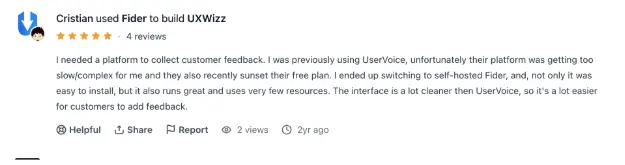
I needed a platform to collect customer feedback. I was previously using UserVoice, unfortunately their platform was getting too slow/complex for me and they also recently sunset their free plan. I ended up switching to self-hosted Fider, and, not only it was easy to install, but it also runs great and uses very few resources."-Cristian (@cristy94), builder of UXWizz (Product Hunt, ~2024)
-
Pricing:
Free (unlimited posts and users, 2 boards) · Starter $29/mo (custom domain, 5 boards) · Professional $59/mo (unlimited boards, SSO, unlimited integrations).
(Source: "UserJot" pricing, Aug 2026)

10. Fider
Fider takes the opposite approach from every other tool on this list: it's open source, self-hostable, and free of the vendor lock-in that comes with any SaaS subscription. A team with the technical capacity to run a Docker container gets a full feedback board, voting, and discussion threads without a recurring bill or a data-residency question. Its track record lives on GitHub rather than review platforms, with several thousand stars and years of active development since its original release, which is a different kind of trust signal than a G2 star rating but a real one for technical teams evaluating it.
Key Features
-
Public feedback board with one-click voting and threaded discussion
-
Admin merge and duplicate detection
-
Tagging and pinning
-
OAuth2 login via Google, Facebook, and GitHub
-
Documented REST API and webhooks
-
Multilingual support
-
Custom branding
-
Fully self-hosted deployment with your own database
Customer fit
-
Best for:
Technical teams and open-source projects that want a lightweight feedback board with no vendor lock-in and no per-seat cost.
-
Not ideal for:
Teams without engineering resources to self-host and maintain it, or anyone wanting AI-assisted triage, managed hosting, or dedicated support included by default.
Reviews and Pricing
-
Reviews:
Fider has no listing on G2 or Capterra, which tracks with its open-source distribution model. Its adoption signal instead comes from sustained GitHub activity, thousands of stars and an actively maintained issue tracker, since the project's original release, more relevant to its actual buyer than a review-platform rating would be.
-
Pricing:
Free to self-host (Docker, your own infrastructure and database). Hosted/managed pricing varies by provider and wasn't independently confirmed at time of writing.
(Source: "Fider" self-hosting, Aug 2026)
Migrating Off UserVoice: What to Export Before You Cancel
Switching away from UserVoice isn't just picking a new tool, it's making sure nothing gets left behind in the account you're closing. A UserVoice account holds more than it looks like from the outside, and losing that on the way out means starting over with the new tool instead of carrying momentum into it. Before you cancel, work through this:
-
Ideas-and-votes history:
Export the full record before you lose access, Canny and Frill both offer direct UserVoice import mapping.
-
Customer or contact data:
Pull anything tied to individual feedback items, not just the feedback text itself.
-
Status history:
Carry over ideas already marked planned or shipped, since that context is what keeps a customer relationship intact through the switch.
-
Parallel run:
Keep the new tool live alongside UserVoice for at least one full feedback cycle before pointing your public board's link or widget at it, so customers aren't voting into two places at once.
-
Embedded integrations:
If UserVoice is embedded inside a support tool rather than run standalone, check whether that integration quietly stops working the day the subscription lapses, since it usually does.
Votes vs. Tickets: Why "Best Alternative" Depends on What You're Actually Replacing
Nine of the ten tools above solve the same underlying job UserVoice does: give customers a place to submit and vote on ideas, then help a product team prioritize what to build. Picking between them comes down to how much strategy tooling you need on top of that (Productboard and Aha! Ideas), how tightly it should tie to revenue data (Savio, Pendo), and how much you want to pay per seat versus flat (UserJot, Fider).
Bottom Line
If you're a product team that just needs somewhere for customers to vote on ideas, Canny and UserJot get you running fastest with transparent, published pricing. If your organization needs a formal roadmap strategy tied to a broader PM process, Productboard and Aha! Ideas are built for that scale.
If prioritization has to be backed by CRM revenue data, Savio is the most purpose-built option here. And if what's actually broken isn't feedback collection but the fact that feature requests are stuck in an unmanaged support queue, HappyFox is worth a look, not as a UserVoice replacement, but as the ticketing system that should have been handling those requests in the first place.
For teams still comparing full help desks more broadly, the Zendesk alternatives and Freshdesk alternatives roundups cover that wider category in more depth.
Get a demo to see how HappyFox routes and tracks feature requests alongside every other ticket your team handles.
Frequently Asked Questions
What is the best UserVoice alternative for SaaS teams?
-
It depends on what you're replacing. For pure feature voting and roadmap visibility, Canny, Frill, or UserJot are the closest fits with transparent, published pricing. For CRM-linked prioritization at CS or sales-influenced companies, Savio is a strong match. If your actual bottleneck is support tickets stacking up with unmanaged feature requests, look at a help desk like HappyFox instead of another feedback board.
Does UserVoice include help desk ticketing?
-
No. UserVoice focuses on collecting and prioritizing feature requests and ideas. It doesn't include SLA enforcement, an omnichannel support inbox, automation rules, or the reporting dashboards a dedicated help desk provides. Teams needing structured ticket resolution typically pair UserVoice with a separate support platform.
Is UserVoice good for customer support teams?
-
UserVoice is strong at collecting product ideas but wasn't built as a customer support platform. It lacks core help desk features like ticket routing, collision detection, mass replies, and SLA tracking, so support teams handling day-to-day tickets usually need a more complete solution alongside it.
Why is UserVoice pricing so hard to find?
-
UserVoice doesn't publish pricing publicly. Every figure that circulates comes from third-party estimates based on sales conversations, not an official rate card. Getting a real number requires booking a call, which is part of why teams evaluating alternatives often gravitate toward tools with transparent, self-serve pricing they can check before a demo.
Can a UserVoice alternative also handle support ticketing, not just feedback?
-
A few can, but only in specific ways. Featurebase bundles a helpdesk inbox alongside its feedback board and roadmap in one subscription. HappyFox takes the opposite approach: it's a full ticketing system that can tag, route, and report on feature requests as they come in through support, rather than a feedback board with light ticketing bolted on. Which one fits depends on whether feedback or ticket resolution is the primary workload.